
Remissão espontânea de Linfoma Difuso de Grandes Células B em paciente com aids
DOI:
https://doi.org/10.5935/2764-734X.e20250956Palavras-chave:
Neoplasm Regression, Spontaneous, Large B-Cell, Diffuse, Lymphoma, AIDS-Related, Antiretroviral Therapy, Highly Active, Case ReportResumo
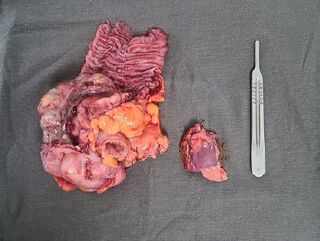
O linfoma difuso de grandes células B (LDGCB) é a neoplasia hematológica linfoide mais comum em pessoas adultas que vivem com HIV/aids. Trata-se de doença de curso agressivo, com frequente doença extranodal, classicamente tratada com quimioterapia. Relatamos o caso de um paciente cujo diagnóstico de aids foi concomitante ao de um linfoma avançado que implicou em uma ressecção intestinal de urgência devido a um quadro de abdome agudo obstrutivo. Decorridas 10 semanas de pós-operatório, entretanto, constatou-se a remissão espontânea do linfoma através de uma tomografia por emissão de pósitrons (PET/CT), informação ratificada por uma nova abordagem cirúrgica para reconstrução do trânsito intestinal após seis meses e por novo exame de PET/CT após um ano. Atribuímos o fenômeno à reconstituição imune alcançada pela terapia antirretroviral e ao uso associado de ganciclovir para tratamento de infecção por citomegalovírus.
Downloads
Referências
Dao A, Kim HY, Garnham K, Kidd S, Sati H, Perfect J, et al. Cryptococcosis: a systematic review to inform the World Health Organization Fungal Priority Pathogens List. Medical Mycology. 2024;62(6):myae043. doi:10.1093/mmy/myae043.
Kwon-Chung KJ, Bennett JE, Wickes BL, Meyer W, Cuomo CA, Wollenburg KR, et al. The case for adopting the “species complex” nomenclature for the etiologic agents of cryptococcosis. mSphere. 2017;2(1):e00357-16. doi:10.1128/mSphere.00357-16.
Speed B, Dunt D. Clinical and host differences between infections with the two varieties of Cryptococcus neoformans. Clinical Infectious Diseases. 1995;21(1):28–34. doi:10.1093/clinids/21.1.28.
Hamamoto Filho PT, Rodríguez-Rivas R, Fleury A. Neurocysticercosis: a review into treatment options, indications, and their efficacy. Research and Reports in Tropical Medicine. 2022;13:67–79. doi:10.2147/RRTM.S375650.
Kimura-Hayama ET, Higuera JA, Corona-Cedillo R, Chávez-Macías L, Perochena A, Quiroz-Rojas LY, et al. Neurocysticercosis: radiologic–pathologic correlation. Radiographics. 2010;30(6):1705–1719. doi:10.1148/rg.306105522.
Rosa-Júnior M, Cots E, Biasutti C. Teaching NeuroImage: cryptococcosis in the central nervous system mimicking neurocysticercosis. Neurology. 2022;98(12):e1302–e1303. doi:10.1212/WNL.0000000000200053.
Do Carmo FN, de Camargo Fenley J, Garcia MT, Rossoni RD, Junqueira JC, de Barros PP, et al. Cryptococcus spp. and cryptococcosis: focusing on the infection in Brazil. Brazilian Journal of Microbiology. 2022;53(3):1321–1337. doi:10.1007/s42770-022-00744-y.
Moretti ML, Resende MR, Lazéra MS, Colombo AL, Shikanai-Yasuda MA. Guidelines in cryptococcosis—2008. Revista da Sociedade Brasileira de Medicina Tropical. 2008;41(5):524–544. doi:10.1590/S0037-86822008000500022.
Trilles L, Lazéra MS, Wanke B, Oliveira RV, Barbosa GG, Nishikawa MM, et al. Regional pattern of the molecular types of Cryptococcus neoformans and Cryptococcus gattii in Brazil. Memórias do Instituto Oswaldo Cruz. 2008;103(5):455–462. doi:10.1590/S0074-02762008000500008.
Bartlett KH, Cheng PY, Duncan C, Galanis E, Hoang L, Kidd S, et al. A decade of experience: Cryptococcus gattii in British Columbia. Mycopathologia. 2012;173(5–6):311–319. doi:10.1007/s11046-011-9475-x.
DeBess E, Cieslak PR, Marsden-Haug N, Goldoft M, Wohrle R, Free C, et al. Emergence of Cryptococcus gattii—Pacific Northwest, 2004–2010. MMWR Morbidity and Mortality Weekly Report. 2010;59(28):865–868. Disponível em: https://www.cdc.gov/mmwr/pdf/wk/mm5928.pdf
Chen SC, Slavin MA, Heath CH, Playford EG, Byth K, Marriott D, et al. Clinical manifestations of Cryptococcus gattii infection: determinants of neurological sequelae and death. Clinical Infectious Diseases. 2012;55(6):789–798. doi:10.1093/cid/cis529.
Saijo T, Chen J, Chen SC, Rosen LB, Yi J, Sorrell TC, et al. Anti–granulocyte-macrophage colony-stimulating factor autoantibodies are a risk factor for central nervous system infection by Cryptococcus gattii in otherwise immunocompetent patients. mBio. 2014;5(2):e00912-14. doi:10.1128/mBio.00912-14.
Yang DH, England MR, Salvator H, Anjum S, Park YD, Marr KA, et al. Cryptococcus gattii species complex as an opportunistic pathogen: underlying medical conditions associated with the infection. mBio. 2021;12(5):e02708-21. doi:10.1128/mBio.02708-21.
Saidykhan L, Onyishi CU, May RC. The Cryptococcus gattii species complex: unique pathogenic yeasts with understudied virulence mechanisms. PLoS Neglected Tropical Diseases. 2022;16(12):e0010916. doi:10.1371/journal.pntd.0010916.
Setianingrum F, Rautemaa-Richardson R, Denning DW. Pulmonary cryptococcosis: a review of pathobiology and clinical aspects. Medical Mycology. 2019;57(2):133–150. doi:10.1093/mmy/myy086.
Howard-Jones AR, Sparks R, Pham D, Halliday C, Beardsley J, Chen SC. Pulmonary cryptococcosis. Journal of Fungi (Basel). 2022;8(11):1156. doi:10.3390/jof8111156.
Anjum S, Dean O, Kosa P, Magone MT, King KA, Fitzgibbon E, et al. Outcomes in previously healthy cryptococcal meningoencephalitis patients treated with pulse taper corticosteroids for post-infectious inflammatory syndrome. Clinical Infectious Diseases. 2021;73(9):e2789–e2798. doi:10.1093/cid/ciaa1901.
Liu J, Li M, Gan ZQ, Wang YJ, Lin CR, Chen ZL, et al. Postinfectious inflammatory response syndrome in HIV-uninfected and nontransplant men after cryptococcal meningitis. Future Microbiology. 2020;15:613–621. doi:10.2217/fmb-2019-0252.
Perfect JR, Dismukes WE, Dromer F, Goldman DL, Graybill JR, Hamill RJ, et al. Clinical practice guidelines for the management of cryptococcal disease: 2010 update by the Infectious Diseases Society of America. Clinical Infectious Diseases. 2010;50(3):291–322. doi:10.1086/649858.
Chang CC, Harrison TS, Bicanic TA, Chayakulkeeree M, Sorrell TC, Warris A, et al. Global guideline for the diagnosis and management of cryptococcosis: an initiative of the ECMM and ISHAM in cooperation with the ASM. The Lancet Infectious Diseases. 2024;24(8):e495–e512. doi:10.1016/S1473-3099(23)00731-4.
Downloads
Publicado
Como Citar
Edição
Seção
Licença
Copyright (c) 2025 Infectologia em Evidência

Este trabalho está licenciado sob uma licença Creative Commons Attribution 4.0 International License.
Todos os usuários podem ler, baixar, compartilhar e adaptar esta produção científica livremente para quaisquer fins (mesmo que comerciais), desde que seja dado o devido crédito aos autores e à publicação original e que qualquer alteração seja devidamente indicada.
> Ética
Todos os artigos publicados na Revista gozam de uma aprovação ética do Sistema Nacional de Ética em Pesquisa (antigo sistema CEP/CONEP) com base na Lei Federal 14.874/24 e outras regulamentações específicas brasileiras ou documento semelhante atestando a ciência e autorização por parte da instituição de origem no caso de trabalhos estrangeiros.
Os autores declaram não haver nenhum tipo de patrocínio ou conflito de interesses, salvo indicação em contrário no corpo do artigo.
Vale ressaltar que os relatos de caso são um valioso recurso de aprendizado para a comunidade científica, mas não devem ser utilizados isoladamente para guiar opções diagnósticas ou terapêuticas na prática clínica ou em políticas de saúde.