Intralesional vimblastine in oral Kaposi Sarcoma
DOI:
https://doi.org/10.5935/2764-734X.e202201008Keywords:
Sarcoma, Kaposi, Injectionsf, Intralesional, Herpesvirus 8, Human, HIV Infections, VinblastineAbstract
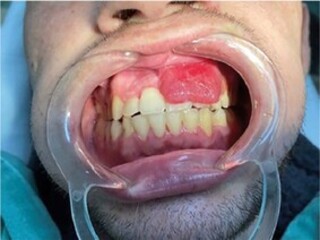
Kaposi’s sarcoma (KS) is a multicentric vascular neoplasm characterized by reddish or violet lesions on the skin, mucous membranes, and other sites. Associated with type 8 herpesvirus, it is more prevalent in men who have sex with men (MSM) and the mouth may be the only site involved. Oral KS treatments include surgical removal, radiation therapy, and intralesional chemotherapy. The objective of this case report was to document and evaluate the effectiveness of treating an oral KS lesion in a patient with AIDS using local injections of vinblastine solution (intralesional chemotherapy), aiming to highlight its positive results in a context of complementary treatment of the neoplasm.
Downloads
References
1. Karamanou M, Antoniou C, Stratigos AJ, Saridaki Z, Androutsos G. The eminent dermatologist Moriz Kaposi (1837-1902) and the first description of idiopathic multiple pigmented sarcoma of the skin. J BUON. 2013 Oct/Dec;18(4):1101-5.
2. Feit H. Sarcoma (Kaposi). Arch Derm Syphilol. 1928;18:611–2 apud Aroua A, Ali RB, Chokri A, Selmi J. Solitary Kaposi’s sarcoma in the oral cavity of an HIV-negative patient: a rare case report. Sch J Med Case Rep. 2017;5(11):713-6.
3. Dittmer DP, Damania B. Kaposi sarcoma-associated herpesvirus: immunobiology, oncogenesis, and therapy. J Clin Invest. 2016 Sep;126(9):3165-75.
4. Beral V, Peterman TA, Berkelman RL, Jaffe HW. Kaposi’s sarcoma among persons with AIDS: a sexually transmitted infection? Lancet. 1990 Jan;335(8682):123-8.
5. Epstein JB. Treatment of oral Kaposi sarcoma with intralesional vinblastine. Cancer. 1993 Mar;71(5):1722-5.
6. Epstein JB, Lozada-Nur F, McLeod WA, Spinelli J. Oral Kaposi’s sarcoma in acquired immunodeficiency syndrome. Review of management and report of the efficacy of intralesional vinblastine. Cancer. 1989 Dec;64(12):2424-30.
7. Fatahzadeh M, Schwartz RA. Oral Kaposi’s sarcoma: a review and update. Int J Dermatol. 2013 Jun;52(6):666-72.
8. McCormick SU. Intralesional vinblastine injections for the treatment of oral Kaposi’s sarcoma: report of 10 patients with 2-year follow-up. J Oral Maxillofac Surg. 1996 May;54(5):583-9.
9. Volberding P, Conant MA, Stricker RB, Lewis BJ. Chemotherapy in advanced Kaposi’s sarcoma. Implications for current cases in homosexual men. Am J Med. 1983 Apr;74(4):652-6.
10. Goncalves PH, Uldrick TS, Yarchoan R. HIV-associated Kaposi sarcoma and related diseases. AIDS. 2017 Sep;31(14):1903-16.
11. Chang Y, Cesarman E, Pessin MS, Lee F, Culpepper J, Knowles DM, et al. Identification of herpesvirus-like DNA sequences in AIDS-associated Kaposi’s sarcoma. Science. 1994 Dec;266(5192):1865-9.
12. Gorsky M, Epstein JB. A case series of acquired immunodeficiency syndrome patients with initial neoplastic diagnoses of intraoral Kaposi’s sarcoma. Oral Surg Oral Med Oral Pathol Oral Radiol Endod. 2000 Nov;90(5):612-7.
13. Lebbe C, Blum L, Pellet C, Blanchard G, Verola O, Morel P, et al. Clinical and biological impact of antiretroviral therapy with protease inhibitors on HIV-related Kaposi’s sarcoma. AIDS. 1998 May;12(7):F45-9.
Downloads
Published
How to Cite
Issue
Section
License
Copyright (c) 2022 Infections in Evidence

This work is licensed under a Creative Commons Attribution 4.0 International License.
All users may freely read, download, share, and adapt this scientific product for any purpose (even commercial ones), provided that due credit is given to the authors and the original publication, and that any alterations are duly indicated.
> Ethics
All articles published herein have received ethical approval from the National Research Ethics System (formerly CEP/CONEP system) based on Federal Law 14.874/24 and other specific Brazilian regulations, or a similar document attesting to the knowledge and authorization from the institution of origin in the case of foreign works.
The authors declare that there is no sponsorship or conflict of interest of any kind, unless otherwise indicated in the body of the article.
It is worth noting that case reports are a valuable learning resource for the scientific community, but should not be used in isolation to guide diagnostic or therapeutic options in clinical practice or health policies