Suspected “Cowpox” in an Immunocompetent Man
DOI:
https://doi.org/10.66004/2764-734X.e20260982Keywords:
Cowpox, Pseudocowpox virus, Poxviridae Infections, skin diseases, lymphadenopathy, case reportAbstract
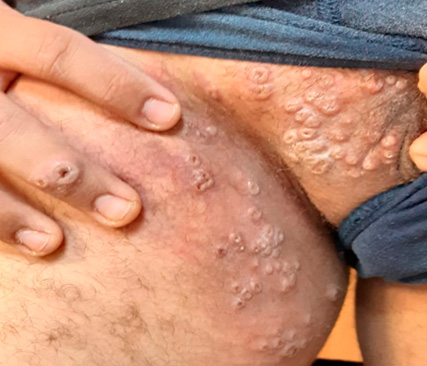
We report the case of a 22-year-old heterosexual male with no prior comorbidities, residing in Caçapava, countryside of São Paulo State, who presented with a painless papular lesion on his right middle finger associated with ipsilateral axillary lymphadenopathy, followed by a cluster of similar lesions in the right inguinal region. The clinical suspicion of cowpox was based on the patient's striking epidemiological history: he worked professionally as a milker and reported direct contact with cows that had "rashes" on their udders, in addition to having previously observed similar lesions on his coworkers' hands. No specific laboratory testing or biopsies were performed (either on the patient or the animals), a fact that prevents us from definitively confirming this clinical suspicion. However, the spontaneous resolution of the lesions helped corroborate this diagnostic hypothesis. Scientific literature research for similar cases revealed that milker's disease most commonly corresponds to the Parapoxvirus genus rather than the Orthopoxvirus genus (which includes cowpox and mpox, among others). Proper clinical and epidemiological knowledge regarding these zoonoses carries relevant diagnostic, therapeutic, and preventive implications.
Downloads
References
[1] Bruneau RC, Tazi L, Rothenburg S. Cowpox Viruses: A Zoo Full of Viral Diversity and Lurking Threats. Biomolecules. 2023; 13(2):325. doi:10.3390/biom13020325
[2] Vorou RM, Papavassiliou VG, Pierroutsakos IN. Cowpox virus infection: an emerging health threat. Curr Opin Infect Dis. 2008; 21(2): 153-6. doi:10.1097/QCO.0b013e3282f44c74
[3] BRASIL. Ministério da Saúde. Secretaria de Vigilância em Saúde e Ambiente. Boletim Epidemiológico de Mpox: situação epidemiológica da Mpox no Brasil. Brasília: Ministério da Saúde, [atualizado em 13/08/2024]. Disponível em: https://www.gov.br/saude/pt-br/centrais-de-conteudo/publicacoes/boletins/epidemiologicos/variola-dos-macacos. Acesso em 09/09/2026.
[4] Handler NS, Handler MZ, Rubins A, Rubins S, Septe M, Janniger CK, et al. Milker’s nodule: an occupational infection and threat to the immunocompromised. J Eur Acad Dermatol Venereol. 2018; 32(4):537-541. Doi: 10.1111/jdv.14687
[5] Thompson HJ, Harview CL, Swick B, Powers JG. Orf Virus in Humans: Case Series and Clinical Review. Cutis. 2022; 110(1):48-52. Doi: 10.12788/cutis.0567
[6] Pauli G, Blümel J, Burger R, Drosten C, Gröner A, Gürtler L, et al. Orthopox Viruses: Infections in Humans. Transfus Med Hemother. 2010; 37(6):351-364. doi: 10.1159/000322101
[7] Henderson DA. The eradication of smallpox--an overview of the past, present, and future. Vaccine. 2011; 29(Suppl 4):D7-D9. doi:10.1016/j.vaccine.2011.06.080
[8] Schatzmayr HG, Costa RVC, Gonçalves MCR, Barreto DF, Batista VH, Silva MVE et al. Infecções humanas causadas por poxvirus relacionados ao vírus vaccinia no Brasil. Rev Soc Bras Med Trop 2009; 42(6):672-6. Doi: 10.1590/S0037-86822009000600012
[9] Abrahão JS, Silva-Fernandes AT, Assis FL, Guedes MI, Drumond BP, Leite JA, et al. Human Vaccinia virus and Pseudocowpox virus co-infection: clinical description and phylogenetic characterization. J Clin Virol. 2010; 48(1):69-72. doi: 10.1016/j.jcv.2010.02.001
[10] Adriano AR, Quiroz CD, Acosta ML, Jeunon T, Bonini F. Nódulo dos ordenhadores - Relato de caso. An Bras Dermatol. 2015; 90(3):407–10. doi: 10.1590/abd1806-4841.20153283
[11] Phillips ZC, Holfeld KI, Lang AL, Richels LD. A case of milker's nodules in Saskatchewan, Canada. SAGE Open Med Case Rep. 2020; 8:2050313X20984118. doi: 10.1177/2050313X20984118.
[12] Wu K, de Menezes S, Robinson A. Erythema Multiforme Induced by a "Milker's Nodule" Pseudocowpox Infection: A Case Report and Review of Literature. Case Rep Dermatol Med. 2021; 2021:5584773. doi: 10.1155/2021/5584773.
[13] Kassa T. A Review on Human Orf: A Neglected Viral Zoonosis. Res Rep Trop Med. 2021; 12:153–72. Doi: 10.2147/RRTM.S306446
[14] Juang S-J, Win K-T, Chen Y-L, Chen H-W, Cheng P-S. Orf Infection on the Scalp of a Taiwanese Woman: A Case Report and Literature Review; Life 2023; 13(2):358. Doi: 10.3390/life13020358
[15] Barraviera SRCS. Diseases caused by poxvirus - orf and milker's nodules: a review. J Venom Anim Toxins incl Trop Dis. 2005; 11(2):102–8. https://doi.org/10.1590/S1678-91992005000200002
[16] BRASIL. Ministério da Saúde. Secretaria de Vigilância em Saúde e Ambiente. Micoses endêmicas: Esporotricose. Guia de Vigilância em Saúde, 6ª ed. 2024; 2(6):647-70. Disponível em: https://www.gov.br/saude/pt-br/centrais-de-conteudo/publicacoes/svsa/vigilancia/guia-de-vigilancia-em-saude-volume-2-6a-edicao/view. Acesso em 07/09/2026.
[17] Espósito ACC, Jorge MFS, Marques MEA, Abbade LPF. Milker's nodules: classic histological findings. An Bras Dermatol. 2017; 92(6):838-840. doi: 10.1590/abd1806-4841.20176923
[18] Poudel GP, Agrawal S, Dhakal S. Milker's nodule: An under-reported and under-diagnosed occupational infection. Clin Case Rep. 2020; 8(7):1162-1165. doi: 10.1002/ccr3.2850
Published
How to Cite
Issue
Section
License
Copyright (c) 2026 Infections in Evidence

This work is licensed under a Creative Commons Attribution 4.0 International License.
All users may freely read, download, share, and adapt this scientific product for any purpose (even commercial ones), provided that due credit is given to the authors and the original publication, and that any alterations are duly indicated.
> Ethics
All articles published herein have received ethical approval from the National Research Ethics System (formerly CEP/CONEP system) based on Federal Law 14.874/24 and other specific Brazilian regulations, or a similar document attesting to the knowledge and authorization from the institution of origin in the case of foreign works.
The authors declare that there is no sponsorship or conflict of interest of any kind, unless otherwise indicated in the body of the article.
It is worth noting that case reports are a valuable learning resource for the scientific community, but should not be used in isolation to guide diagnostic or therapeutic options in clinical practice or health policies