
Thalidomide as Adjunctive Therapy in a Case of HIV-Associated Idiopathic Esophageal Ulcer
DOI:
https://doi.org/10.66004/2764-734X.e20260675Keywords:
AIDS-Related Opportunistic Infections, Esophageal Diseases, Thalidomide, Case ReportAbstract
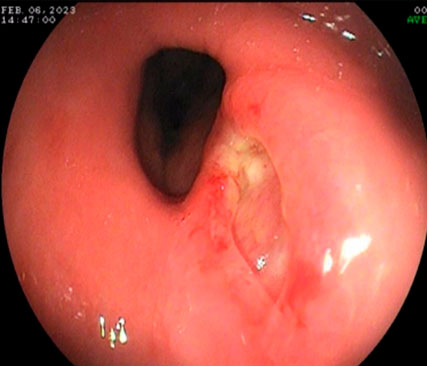
HIV-associated idiopathic esophageal ulcer is a rare manifestation of advanced immunosuppression with no well-established therapeutic management. We report the case of a 19-year-old female patient presenting with epigastric pain, odynophagia, and weight loss, whose endoscopy identified an extensive ulcer in the distal esophagus. The biopsy of this lesion was nonspecific, and serological testing revealed HIV infection. The blood CD4 cell count was 5 cells/µL, and antiretroviral therapy was promptly initiated. A second endoscopy revealed worsening of the inflammatory process and the esophageal ulcer; despite the lack of an etiological diagnosis, empirical treatment with ganciclovir was chosen, which was later switched to foscarnet. The absence of clinical improvement even after two weeks of treatment prompted a new examination, whose endoscopic findings showed an even more pronounced worsening of the lesion, with equally inconclusive biopsies. Thus, a diagnosis of HIV-associated idiopathic ulcer (potentially aggravated by a possible immune reconstitution inflammatory syndrome) was considered, and the introduction of thalidomide at 100 mg/day was decided. After four weeks, there was clinical resolution and complete endoscopic healing, confirming the immunomodulatory and anti-inflammatory role of thalidomide as a potential adjunctive therapy in this type of scenario without proven causality.
Downloads
References
1. Lv B, Cheng X, Gao J, Zhao H, Chen L, Wang L, et al. Human immunodeficiency virus (HIV) is highly associated with giant idiopathic esophageal ulcers in acquired immunodeficiency syndrome (AIDS) patients. Am J Transl Res. 2016; 8(10):4464-4471. PMID: 27830031; PMCID: PMC5095340.
2. Wilcox CM, Straub RF, Schwartz DA. Prospective endoscopic characterization of cytomegalovirus esophagitis in AIDS. Gastrointest Endosc. 1995; 42(6):573-577. doi: 10.1016/s0016-5107(94)70215-2
3. National Institutes of Health; HIV Medicine Association of the Infectious Diseases Society of America Panel on Opportunistic Infections in Adults and Adolescents With HIV. Guidelines for the Prevention and Treatment of Opportunistic Infections in Adults and Adolescents With HIV [Internet]. Bethesda (MD): National Institutes of Health; updated 2026 May 27 [cited 2026 Jun 16]. Available from: https://www.ncbi.nlm.nih.gov/books/NBK586304/
4. Jacobson JM, Spritzler J, Fox L, Fahey JL, Jackson JB, Chernoff M, et al. Thalidomide for the treatment of esophageal aphthous ulcers in patients with human immunodeficiency virus infection. J Infect Dis. 1999; 180(1):61-67. doi:10.1086/314834
5. Alexander LN, Wilcox CM. A prospective trial of thalidomide for the treatment of HIV-associated idiopathic esophageal ulcers. AIDS Res Hum Retroviruses. 1997; 13(4):301-304. doi:10.1089/aid.1997.13.301
6. Deeks SG, Overbaugh J, Phillips A, Buchbinder S. HIV infection. Nat Rev Dis Primers. 2015; 1:15035. doi:10.1038/nrdp.2015.35
7. Brenchley JM, Douek DC. Microbial translocation across the gastrointestinal tract. Annu Rev Immunol. 2012; 30:149-173. doi:10.1146/annurev-immunol-020711-075015
8. Altenburg A, El-Haj N, Micheli C, Puttkammer M, Abdel-Naser MB, Zouboulis CC. The treatment of chronic recurrent oral aphthous ulcers. Dtsch Arztebl Int. 2014; 111(40):665-673. doi: 10.3238/arztebl.2014.0665
9. Lau CB, Smith GP. Recurrent aphthous stomatitis: a comprehensive review and recommendations on therapeutic options. Dermatol Ther (Heidelb). 2022; 35(6):e15500. doi:10.1111/dth.15500
10. Jian Y, Wang F, Zhao M, Han X, Wang X. Efficacy and safety of thalidomide for recurrent aphthous stomatitis. BMC Oral Health. 2024; 24:1149. doi:10.1186/s12903-024-04923-1
11. Bousvaros A, Mueller B. Thalidomide in gastrointestinal disorders. Drugs. 2001; 61(6):777-787. doi:10.2165/00003495-200161060-00006
12. Fabian E, Königsbrügge O, Krejs GJ, Unseld M. Thalidomide for the management of gastrointestinal bleeding in a palliative care setting. Oncology. 2023; 101(2):107-112. doi:10.1159/000533437
13. Lichtenstein GR, Hanauer SB, Sandborn WJ. Management of Crohn's disease in adults. Am J Gastroenterol. 2009; 104(2):465-483. doi:10.1038/ajg.2008.174
14. Wang X, Xiong K, Huang F, Huang J, Liu Q, Duan N, et al. A metagenome-wide association study of the gut microbiota in recurrent aphthous ulcer and regulation by thalidomide. Front Immunol. 2022; 13:1018567. doi:10.3389/fimmu.2022.1018567
15. Lin D, Yang L, Wen L, Lu H, Chen Q, Wang Z. Crosstalk between the oral microbiota, mucosal immunity, and the epithelial barrier regulates oral mucosal disease pathogenesis. Mucosal Immunol. 2021; 14(6):1247-1258. doi:10.1038/s41385-021-00413-7
Published
How to Cite
Issue
Section
License
Copyright (c) 2026 Infections in Evidence

This work is licensed under a Creative Commons Attribution 4.0 International License.
All users may freely read, download, share, and adapt this scientific product for any purpose (even commercial ones), provided that due credit is given to the authors and the original publication, and that any alterations are duly indicated.
> Ethics
All articles published herein have received ethical approval from the National Research Ethics System (formerly CEP/CONEP system) based on Federal Law 14.874/24 and other specific Brazilian regulations, or a similar document attesting to the knowledge and authorization from the institution of origin in the case of foreign works.
The authors declare that there is no sponsorship or conflict of interest of any kind, unless otherwise indicated in the body of the article.
It is worth noting that case reports are a valuable learning resource for the scientific community, but should not be used in isolation to guide diagnostic or therapeutic options in clinical practice or health policies